
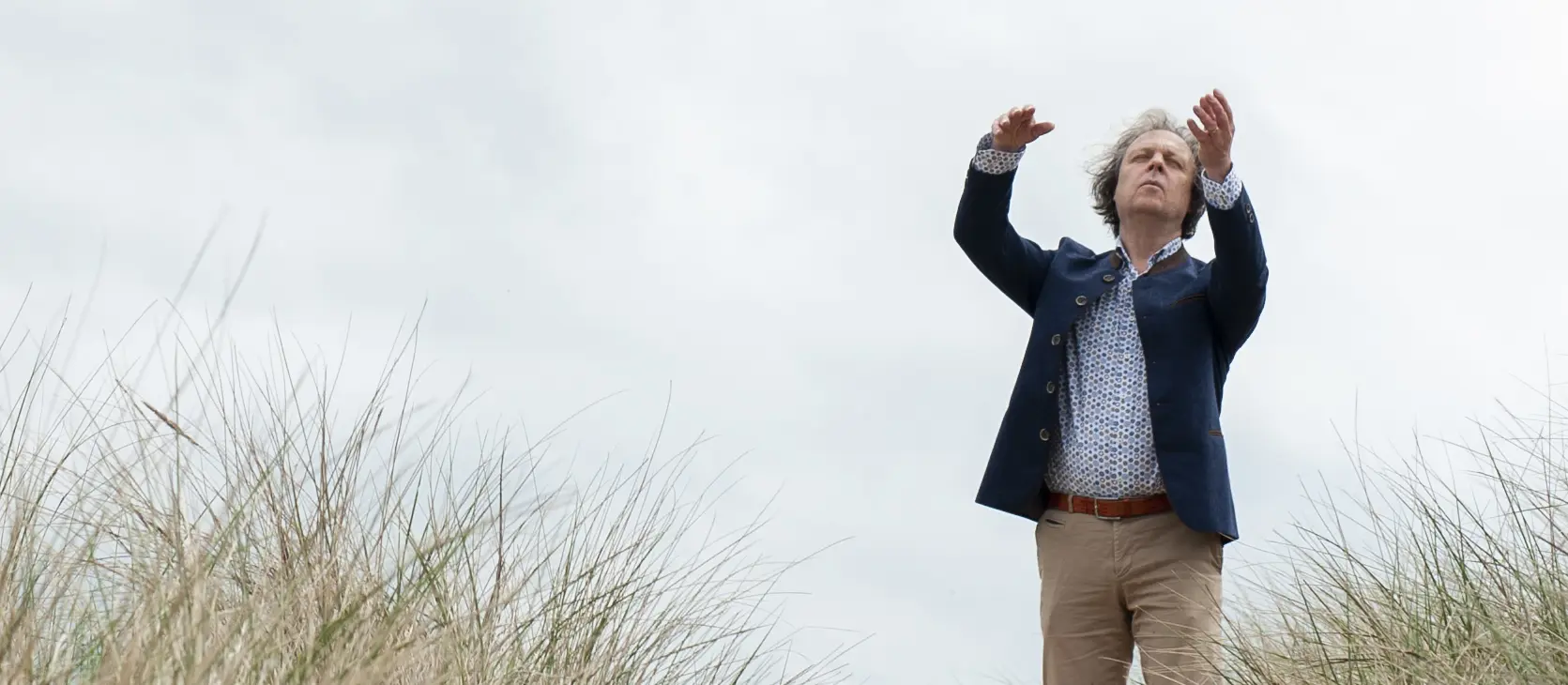
About Tommie Haglund
Tommie Haglund is a Swedish composer whose music has been in demand internationally for many years, and increasingly so in recent times, with a growing intensity. His work has received prestigious prizes and awards. Among the qualities that have fascinated and moved both listeners and performers is the strong sense of absolute honesty—a naked confession of the soul—that permeates everything he has composed.
In November 2014, he was awarded one of the finest prizes a Nordic composer can receive, the Royal Swedish Academy of Music’s prestigious Christ Johnson Prize. The prize is awarded for orchestral works written in recent years, and was given to his cello concerto Flaminis Aura, with the following citation: “With liberating seriousness and a personal voice, Tommie Haglund invites the listener into his poetic universe. The cello concerto Flaminis Aura is music that moves forward with an ever-present lyricism.” There was a certain delay in the recognition, since Flaminis Aura was actually written as early as 2002—but this only demonstrates that Haglund’s music continues to live and arouse interest, despite the fact that he has never belonged to the inner circles of the capital’s musical establishment.
Haglund was born in Kalmar in 1959 and is now based in Halmstad. He has been extensively commissioned by cultural institutions, particularly in southern Sweden. For Halmstad’s 700th anniversary in 2007, Haglund was commissioned to write a song cycle. His aforementioned cello concerto received its premiere in Helsingborg, as did his violin concerto Hymns of the Night, composed shortly beforehand and performed by the American violinist Elizabeth Pitcairn on her famous Stradivarius, “The Red Violin”.
Although Haglund began composing at the age of eleven, he did not undertake formal composition studies until after completing his studies in classical guitar in Aarhus and with John Mills in London. He studied composition with Sven Eric Johanson and later sought private instruction from Eric Fenby, the former amanuensis of Frederick Delius and professor of composition at the Royal Academy in London. There is a certain affinity between Delius’s dreamlike and sensual music and Haglund’s personally sensitive visions. One might also be reminded of Scriabin.
His breakthrough came in 1988 with Intensio Animi, commissioned by the Swedenborg Society to commemorate the 300th anniversary of Emanuel Swedenborg’s birth. Similarly, Haglund wrote Röstens dotter in 2003 to mark the 700th anniversary of Saint Bridget of Sweden. The work was performed at Vadstena Abbey Church in the presence of representatives of the Vatican and ambassadors from numerous countries. It was awarded the Swedish Music Publishers Association’s prize for “the year’s most significant serious work”. He wrote the string quartet Il regno degli spiriti for the 30th anniversary of the Medicis Quartet, who gave its world premiere at the Cambridge Summer Music Festival in 2001.
During July and August 2014, Tommie Haglund was composer-in-residence at the Luzern Music Centre in New York State, where he gave seminars and had seven chamber works performed in three concerts. Among them was a work dedicated to the memory of Delius, To the Sun-set Breeze (harp, guitar and string quartet), as well as Sollievo dopo la tempesta (string trio), Il regno degli spiriti (string quartet), La Rosa Profunda (soprano and piano), Epilogue to Hymns to the Night (solo violin), and Serenata per Diotima (string orchestra). He has also been a guest lecturer in Canada and the United Kingdom.
As a composer, Tommie Haglund follows his own path, remaining true only to himself. The result is a deeply subjective music that some might venture to call Romantic, reaching directly into the listener, from heart to heart. His music contains a sense of pain, perhaps motivated in part by the physical pain he himself experiences as a result of a severe back injury, but transformed into something that becomes readily recognizable to us all. An open mind can easily identify with Haglund’s music. In 2013, Swedish television broadcast a documentary about Haglund’s life and work, Själens Musik (“The Music of the Soul”). In autumn 2014, he received the Grand Christ Johnson Prize from the Royal Swedish Academy of Music, and in January 2015 he was awarded the HMK Medal for “Significant Contributions to Swedish Music”. In spring 2015, a work for organ received its world premiere at St. Nikolai Church in Halmstad. At the time, he was working on a symphony and a piano concerto.
In 2019, a composer festival devoted to Tommie Haglund’s music was held at Stockholm Concert Hall, where a symphony commissioned from him also received its world premiere.
Three Haglund Festivals have taken place in Halmstad since 2016 (see the link to the most recent festival). The festival is dedicated to Tommie Haglund’s music as well as to composers who have inspired him. It invites orchestras and soloists, both Swedish and international. Collaborations also take place with students and teachers from Sturegymnasiet and the Municipal School of Arts, as well as with various amateur orchestras and choirs in Halmstad.
At the most recent festival, a book about Tommie Haglund and his music was also released: Ögonblickets oändlighet (“The Infinity of the Moment”), written by the American musicologist and anthropologist Aram Yardumian and published by Themis.
Tommie Haglund has recently completed a piano concerto commissioned by the Gothenburg Symphony Orchestra, as well as a song cycle in collaboration with, among others, Per Gessle, who provided the texts. In addition, an opera is being planned in collaboration with librettist Eva Sommestad, concerning Queen Christina’s final years in Rome, as well as a guitar concerto.
A planned collaboration concerning my compositions with the Royal Academy of Music in London is also underway. The project involves Chika Roberson and Mark Ross Clarke, Artistic Director of the British Opera Academy, with Sir Simon Rattle as patron.
An interview and concerts at Scandinavia House and Juilliard in New York are planned for 2027.
Links